Spliced and Vulcanized O-rings and Seals
For applications in which traditional molded O-rings are unsuitable, spliced and vulcanized O-rings can provide an effective solution.
What are Spliced and Vulcanized Seals?
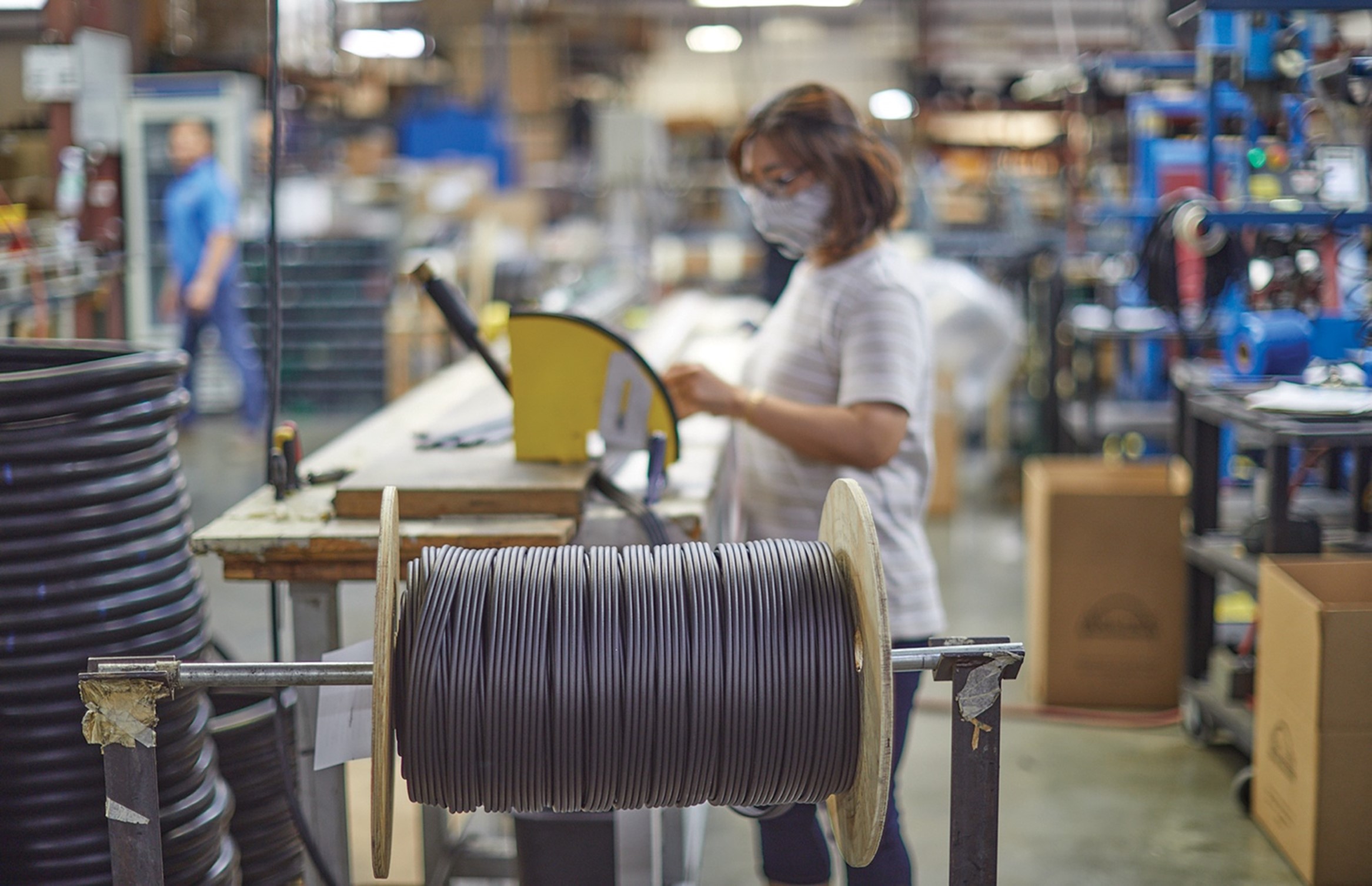
In contrast to molded seals, which are formed as one piece in a mold, spliced and vulcanized seals are made from extruded stock. To produce a spliced and vulcanized seal, continuous stock is cut to a precice length. Next, the ends are bonded together. Finally the spliced seal is vulcaniced in a heated mold. The vulcanization process creates the molecular bond needed to transform the spliced seal into a strong continuous seal.
Why Choose Spliced and Vulcanized O-rings?
OEMs often choose spliced and vulcanized O-rings for applications that demand large diameter seals, smaller quanties, and/or rapid turn-around delivery. They are most often used in static applications, but can also be effective in dynamic applications if the seal doesn’t come into contact with the moving parts.
A spliced and vulcanized O-ring can generally withstand up to approximately 1,200 PSI. They are used in numerous industries including, automotive, transportation, construction, food processing, power generation, and more.
Advantages of Spliced & Vulcanized O-rings
- Minimal Tooling Costs
- Large Diameters and Non-standard Sizes
- Short Turnaround Times
- Strong Consistent Bond
- Wide Variety of Polymers
Key Factors to Consider
A number of key factors must be considered in specifying a spliced and vulcanized O-ring, including:
- Material – Polymer, color, durometer
- Cross Section (CS) – Thickness of the stock
- Cut Length (CL) – Based on the diameter of the
O-ring (see below).
Calculating the Cut Length
The circumference of the O-ring must be calculated to determine the length of stock needed to form the O-ring. Some important dimensional terms for spliced and vulcanized O-rings include:
- CL = Cut Length
- ID = Inside Diameter
- OD = Outside Diameter
- CS = Cross Section
Calculate the Stock Length Needed:
Stock Cut Length Formula:
(( OD + ID ) / 2 ) x Pi (3.14159) = CL
Calculate the Inside Diameter:
OD – CS x 2 = ID
Calculate the Inside Diameter:
OD – CS (cross section) x 2 = ID
Sealing Materials
Archer offers a full range of elastomeric materials for a broad range of fuel-resistant and non-fuel resistant applications. Common elastomeric seal materials include, EPDM, Neoprene, Silicone, and FKM.
EPDM is widely used in sealing applications for its durability, flexibility, and resistance to weather, ozone, and water.
Neoprene seals are used across many industries because they resist oils, weather, and chemicals. Common applications include automotive, enclosure, and marine uses.
Silicone offers excellent temperature resistance, durability, and flexibility, making it ideal for harsh environments. Silicone seals also provide strong resistance to weathering, chemicals, and UV exposure.
FKM materials (like Viton®) provide excellent resistance to high temperatures. FKM also performs extremely well in and offers strong protection against fuels, oils, many acids, ozone, oxygen, and UV radiation. These properties make them suitable for demanding applications, particularly in the automotive and energy industries.