
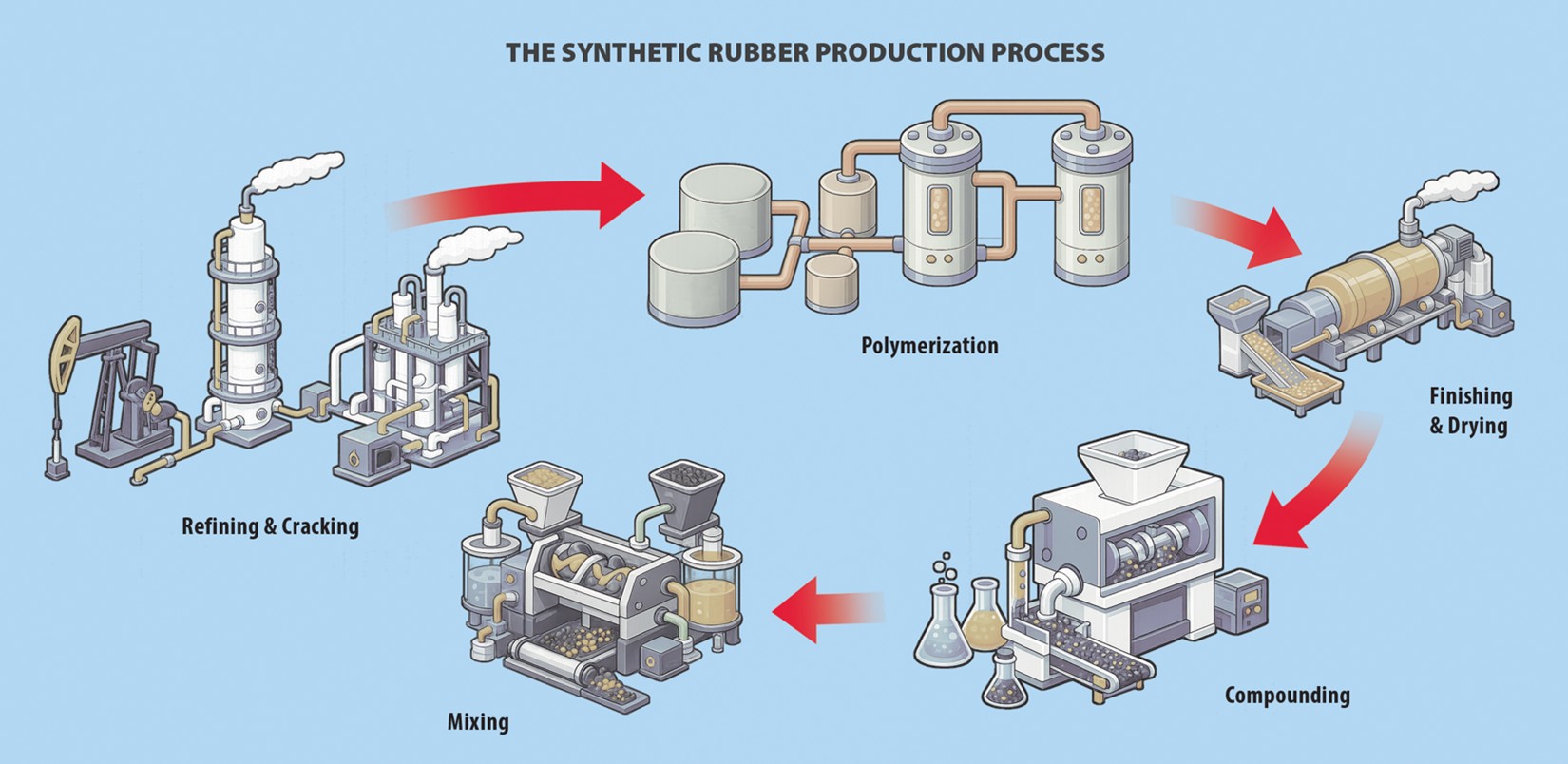
Synthetic rubber production begins in the oil refinery, where crude oil is converted into naphtha and then broken down into key chemical intermediates. These feedstocks are transformed into long-chain polymers and subsequently engineered through controlled processing and mixing to achieve precise performance characteristics.
Refining & Cracking
Crude oil is refined into naphtha and combined with natural gas liquids, then subjected to high-temperature
cracking to yield monomers such as styrene and butadiene.
Polymerization
These monomers are reacted — typically in the presence of catalysts — to form long molecular chains, creating the base elastomer.
Finishing & Drying
The polymer is separated from process water, washed, and dried using mechanical and thermal methods before being formed into bales for downstream handling.
Compounding
The base rubber is introduced into an internal mixer, where reinforcing fillers, process oils and stabilizers are incorporated to establish core physical properties and ensure consistency.
Final Mixing
Curatives, including sulfur and accelerators, are added in a controlled, lower-temperature stage to avoid premature crosslinking and to prepare the compound for shaping and curing.
This staged approach to mixing produces a uniform compound tailored for strength, flexibility and processing stability in subsequent molding and vulcanization operations.